
Connecting Global Research, International Best Practices and Evidence-Based Policymaking
TSUULL promotes sustainable development through international academic collaboration, comparative research and cooperation with national government institutions. The University connects international knowledge and research expertise with national development priorities, contributing to the development of evidence-based approaches to education, language policy, cultural preservation, gender equality and institutional development.
Through international research networks, academic partnerships and government collaboration, TSUULL reviews approaches adopted in different countries, exchanges institutional experience and develops research-based solutions relevant to Uzbekistan's sustainable development priorities.
The University's engagement focuses on two complementary areas: reviewing international approaches and developing transferable practices for achieving the Sustainable Development Goals, and undertaking policy-focused research in cooperation with government departments and public institutions.
International Research Networks and Partnerships
The University's international engagement includes cooperation and knowledge exchange through the following programmes and networks:
- Erasmus+ Programme: Academic mobility, capacity-building and higher education cooperation through initiatives such as KA171, Capacity Building in Higher Education and Jean Monnet activities.
- Higher Education Reform Experts (HERE) Network: Exchange of expertise and comparative approaches to higher education governance, quality assurance, internationalisation and policy development.
- Sustainable Development Solutions Network (SDSN): International academic and research cooperation focused on knowledge sharing and developing solutions to global sustainable development challenges.
- Horizon Europe: European research and innovation framework supporting international collaboration on global challenges, including education, environmental sustainability and the SDGs.
International Academic Partnerships
TSUULL cooperates with international universities to exchange academic expertise, strengthen research connections and explore approaches to sustainable development, education and institutional development.
- University of Bialystok — Poland
An academic partner supporting international cooperation and the exchange of research and educational experience.
- Ca' Foscari University of Venice — Italy
An internationally oriented university with research and academic activities across humanities, languages, culture and sustainability.
- Ankara Hacı Bayram Veli University — Türkiye
A public university with academic expertise in humanities, social sciences, arts and cultural studies.
- University of Ss. Cyril and Methodius in Trnava — Slovakia
A university offering opportunities for academic exchange and cooperation across humanities, social sciences and other research fields.
International Research Collaboration and Best Practice Development
TSUULL strengthens its contribution to the Sustainable Development Goals through international academic partnerships and research-based initiatives. By collaborating with international institutions and national development organisations, the University develops digital educational resources, advances Uzbek language technologies and explores innovative approaches to inclusive and accessible education.
The University's research activities include the following projects:
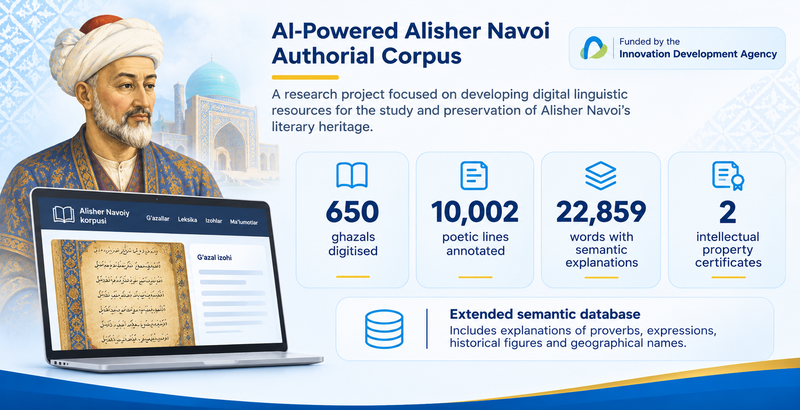
AI-Powered Alisher Navo'i Authorial Corpus
Government-supported research through Innovation Development Agency of Uzbekistan
Developed by TSUULL researchers with funding and institutional support from Uzbekistan's Innovation Development Agency, this research project advances the digital preservation and computational study of Alisher Navoi's literary heritage.
- Established a semantic database covering 650 ghazals from Badoye' ul-vasat.
- Digitally annotated 10,002 poetic lines.
- Compiled 22,859 words requiring semantic explanation.
- Developed explanatory databases covering proverbs, expressions, historical figures and geographical names.
- Secured 2 intellectual property certificates for the corpus and its semantic tagging database.
Uzacademy – Digital Platform for Uzbek Language and Cultural Learning
Developed through cooperation with the El-Yurt Umidi Foundation and the University of Oxford, Uzacademy provides a digital learning environment for studying the Uzbek language and exploring national culture.
- Offers Uzbek language courses from A1 to C1 levels.
- Provides video lessons and interactive exercises.
- Develops listening, reading, writing and speaking skills.
- Includes educational resources on Uzbek history, literature, art and traditions.
- Supports Uzbek language and cultural education internationally, including use in the Uzbek Studies programme at the University of Oxford.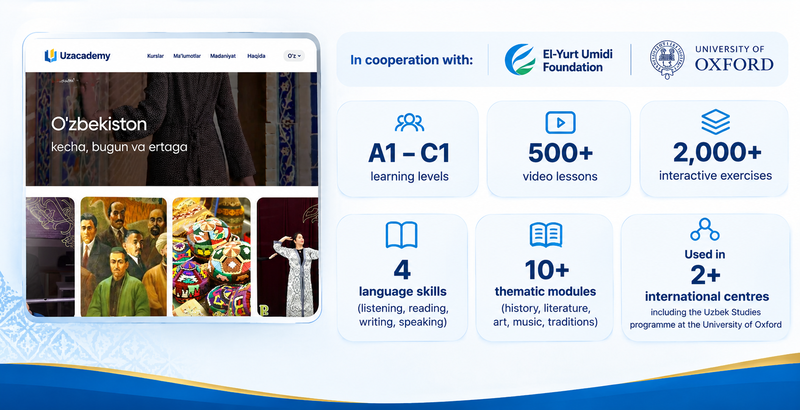
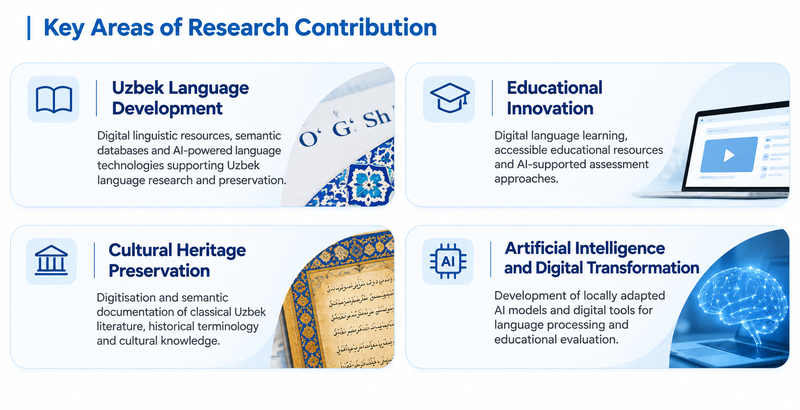
Through these research and innovation initiatives undertaken in 2025, TSUULL demonstrates how international academic collaboration, research-based innovation and government-supported projects can contribute to sustainable development priorities. The projects support the exchange and application of knowledge, the development of locally relevant solutions and the advancement of Uzbek language technologies, digital education and cultural heritage preservation.
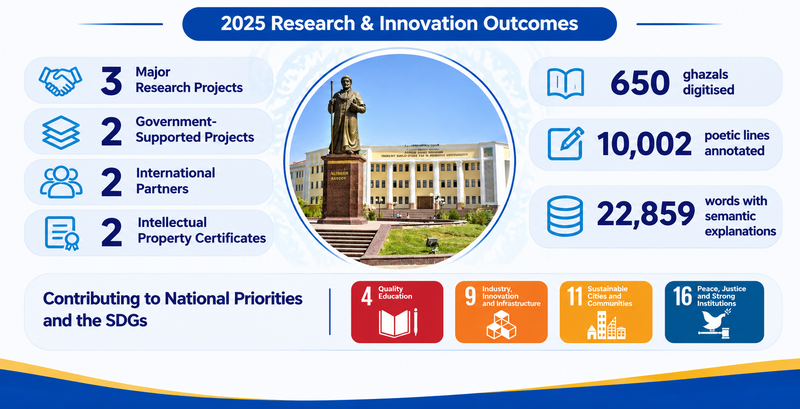
Collectively, these initiatives demonstrate TSUULL's active contribution to international academic cooperation, the exchange of best practices and research-driven innovation. Through international partnerships and government-supported research projects undertaken in 2025, the University has developed practical solutions that support national development priorities and contribute to the achievement of the SDGs.
TSUULL's Contribution to National Research and Policy Priorities
TSUULL undertakes research and develops practical digital solutions that support national priorities in education, language development, cultural preservation and digital transformation. Through collaboration with international partners and national research funding institutions, the University contributes to the development of evidence-based approaches and technologies relevant to Uzbekistan's educational and cultural landscape.
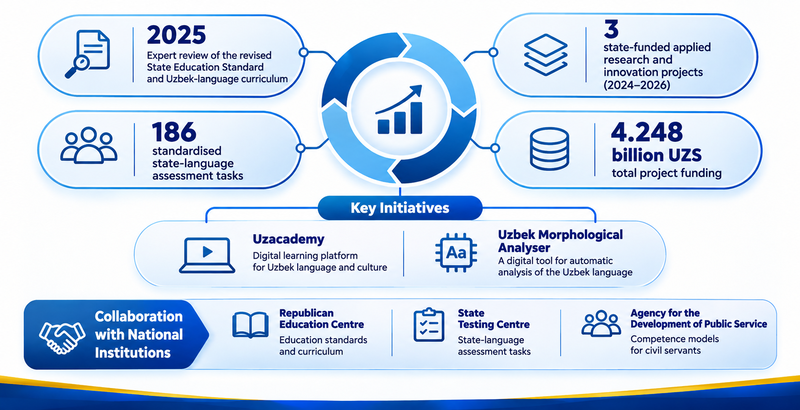
In 2025, the University's scholars participated in the expert review of the revised State Education Standard and Uzbek-language curriculum at the Republican Education Centre. In collaboration with the State Testing Centre, TSUULL developed 186 standardised state-language assessment tasks, while cooperation with the Agency for the Development of Public Service supports the development of competency models for civil servants.
Furthermore, during 2024–2026, the University carried out three state-funded applied research and innovation projects, with a combined value of 4.248 billion UZS. These initiatives include the development of the Uzacademy digital learning platform and an Uzbek morphological analyser, contributing to evidence-based policy development, educational innovation and the advancement of Uzbek-language technologies.
IBIT – AI-Powered Written Assessment Platform
Government-supported joint research with the Innovation Development Agency
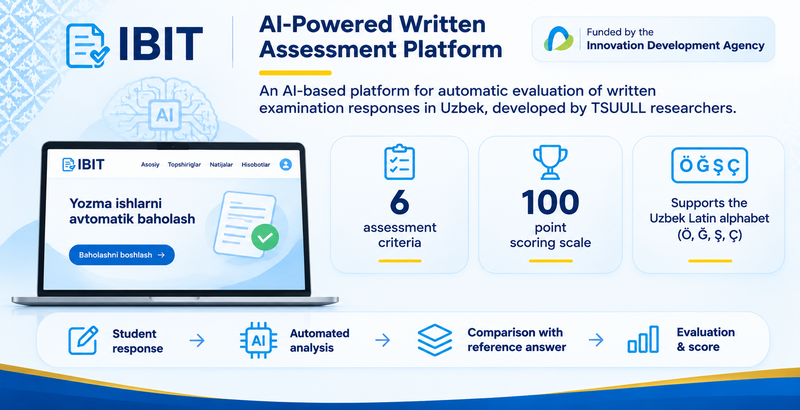
Developed by researchers from TSUULL's Department of Computational Linguistics and Digital Technologies, IBIT is a research initiative supported by the Innovation Development Agency. The project applies a locally adapted artificial intelligence model to the assessment of written examination responses in Uzbek, contributing to research on educational technology and the digital transformation of assessment.
- Automatically analyses students' written examination responses.
- Compares answers with reference responses based on semantic similarity.
- Evaluates performance against six academic assessment criteria.
- Applies a 100-point scoring scale.
- Processes texts using the updated Uzbek Latin alphabet, including Ö, Ğ, Ş and Ç.
Together, these initiatives demonstrate TSUULL’s capacity to translate academic research into practical solutions addressing national educational and linguistic priorities. Through collaboration with government institutions and research funding agencies, the University contributes to evidence-based policymaking, the modernisation of educational assessment, and the development of digital technologies for the Uzbek language.
In 2025, TSUULL scholars participated in the expert review of the revised State Education Standard and Uzbek-language curriculum at the Republican Education Centre, contributing academic expertise to national education reform.
Through cooperation with the Agency for the Development of Public Service, TSUULL contributes to developing competency models for civil servants, supporting professional development and effective public administration.
Research initiatives include the development of the Uzacademy digital learning platform and an Uzbek morphological analyser, advancing digital resources for language learning, linguistic research and Uzbek-language processing.
In collaboration with the State Testing Centre, TSUULL developed 186 standardised state-language assessment tasks, supporting the development of assessment resources for Uzbek-language proficiency.
During 2024–2026, TSUULL implemented three state-funded applied research and innovation projects with a combined value of 4.248 billion UZS, addressing national priorities in education and language technology.
Through collaboration with the Innovation Development Agency, TSUULL researchers developed IBIT, an AI-powered written assessment platform that evaluates Uzbek-language examination responses using six academic criteria and a 100-point scoring scale.
Government-Funded Research on Islamic Civilisation and National Cultural Heritage
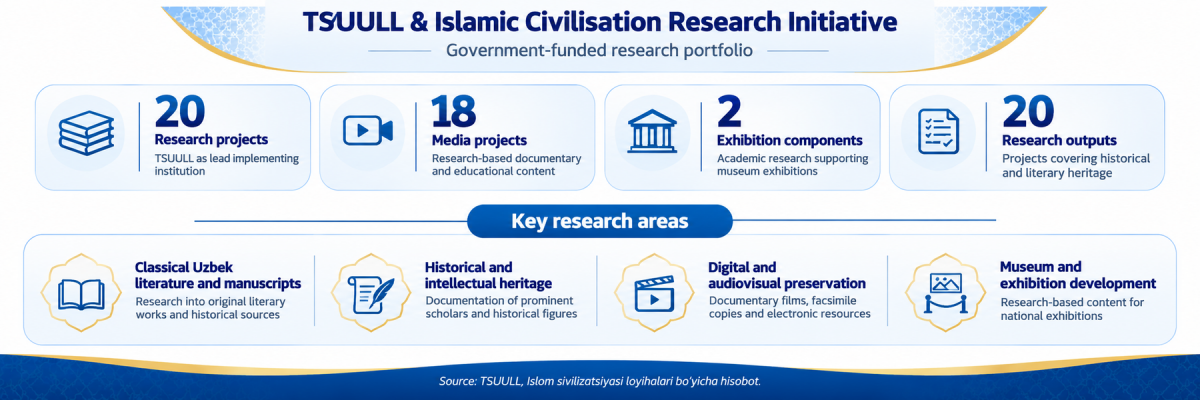
TSUULL serves as a lead implementing institution in a major research initiative funded by the Centre of Islamic Civilisation in Uzbekistan. The University participates in 20 scholarly and cultural heritage projects, contributing research on classical Uzbek literature, historical manuscripts, prominent scholars and the intellectual heritage of the region. The projects combine academic research with the production of documentary films, digital manuscript resources and materials for national museum exhibitions, supporting the preservation, documentation and public dissemination of Uzbekistan's literary and cultural heritage.
International Academic Collaboration – Oxford–TSUULL Summer School
Exploring the Silk Road and Uzbekistan's Cultural Heritage
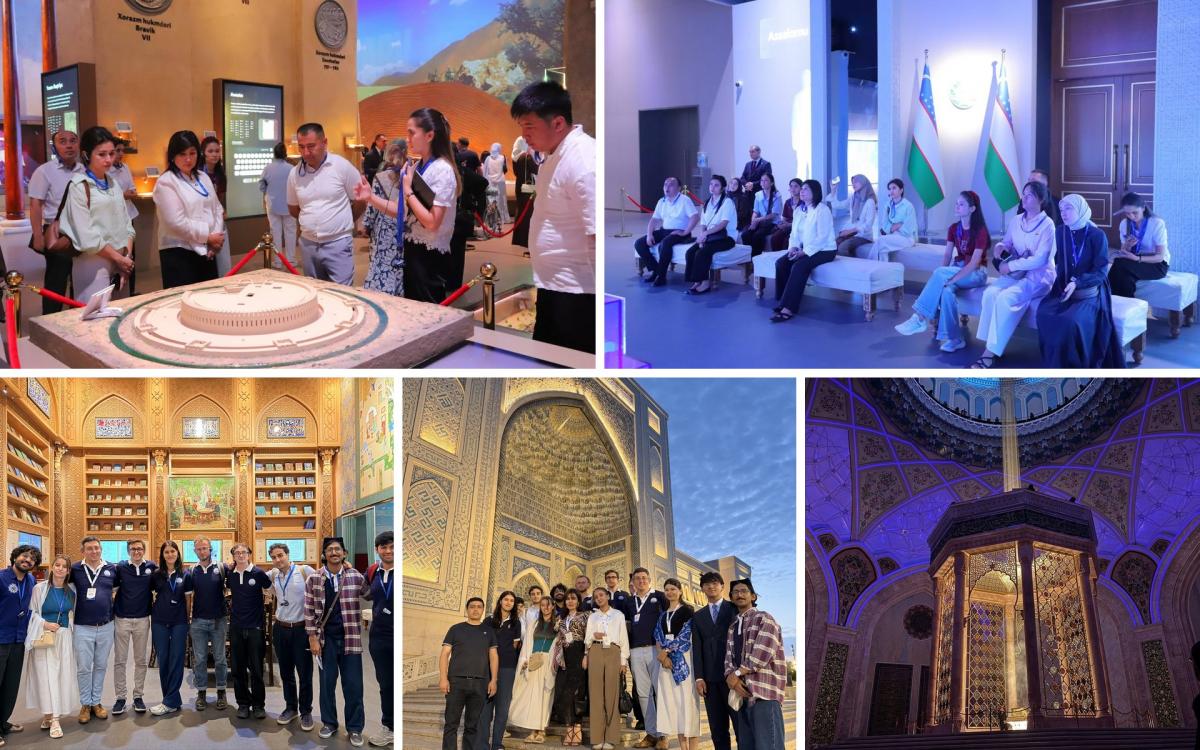
TSUULL organised an international summer school in cooperation with the University of Oxford and the El-Yurt Umidi Foundation as part of Oxford University's Uzbek Studies Programme. The initiative brought together international academic expertise and Uzbekistan's educational, linguistic and cultural resources, providing an immersive learning environment for Oxford students. The programme combined intensive Uzbek-language instruction with historical research, manuscript studies, cultural heritage education and practical learning experiences. It also introduced internationally developed academic approaches to teaching languages through authentic cultural contexts and digital learning resources.
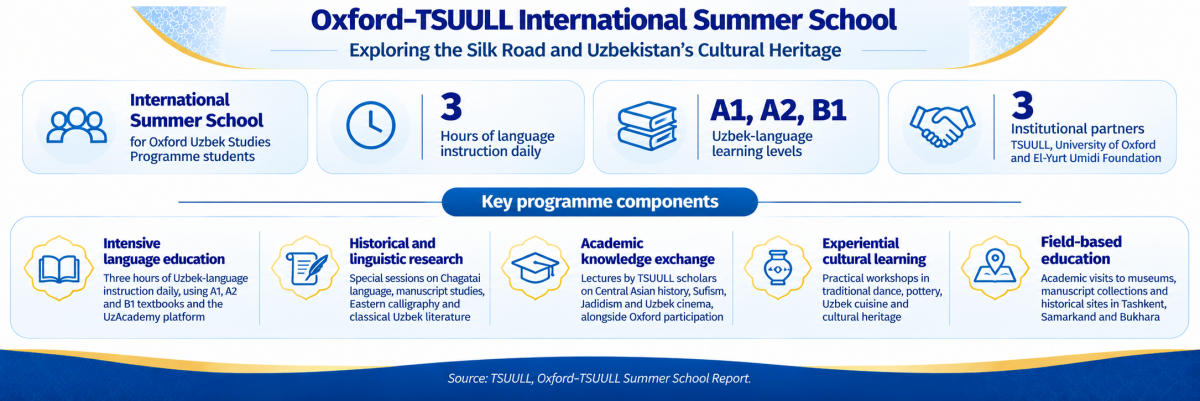
The programme strengthened academic links between TSUULL and Oxford, while demonstrating how international teaching practices, locally developed educational resources and direct cultural engagement can be integrated into a comprehensive model of international language and heritage education.
Technical Assistance Mission Seminar: Inclusive Internationalisation
International collaboration and the development of best practices
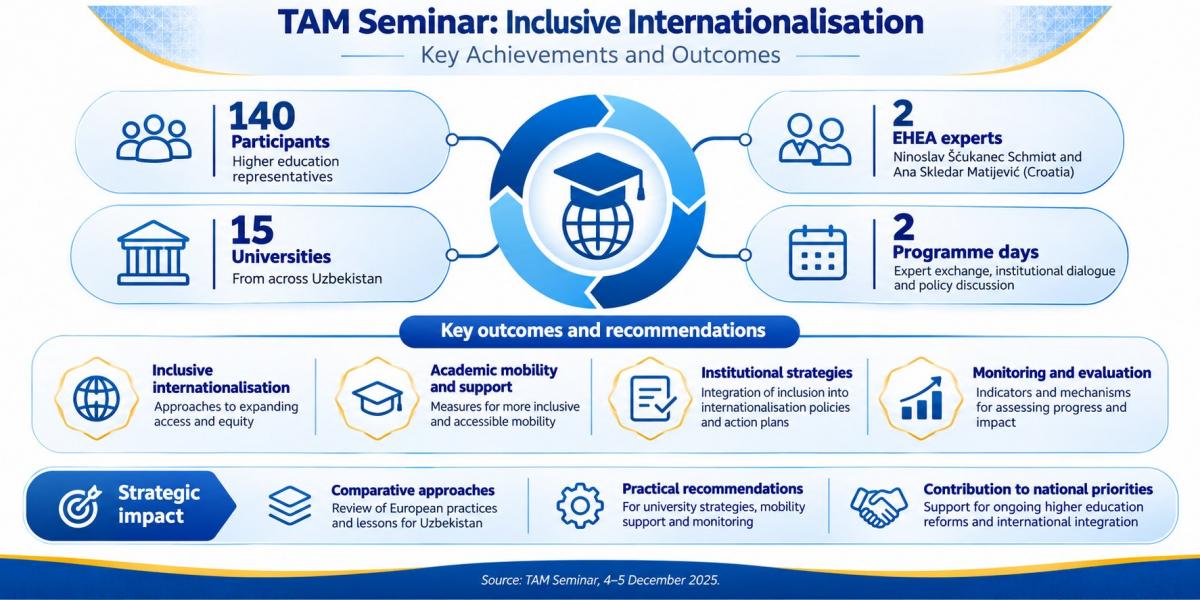
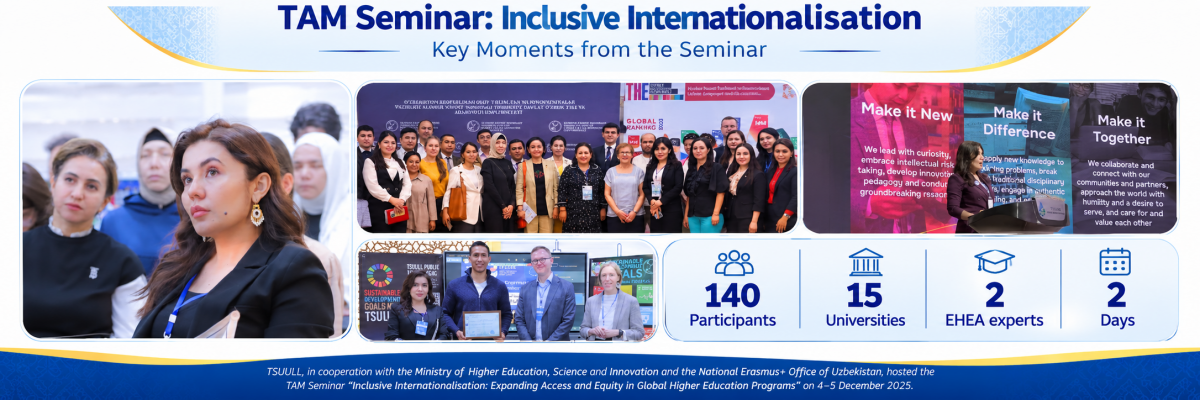
TSUULL hosted the two-day Technical Assistance Mission Seminar, “Inclusive Internationalisation: Expanding Access and Equity in Global Higher Education Programmes”, on 4–5 December 2025, in cooperation with the Ministry of Higher Education, Science and Innovation and the National Erasmus+ Office of Uzbekistan, within the framework of the EU-funded Erasmus+ Programme. The seminar brought together two European Higher Education Area (EHEA) experts, Ninoslav Šćukanec Schmidt and Ana Skledar Matijević, and approximately 140 representatives from 15 universities. Through expert presentations, institutional case studies and collaborative discussions, participants examined European approaches to inclusive internationalisation, equitable academic mobility, accessibility and institutional support. The exchange enabled Uzbek higher education institutions to explore and compare international practices and identify approaches that could be adapted to the national context.
Research-informed innovation and support for national policy priorities
The seminar also provided a platform for translating international expertise into practical policy recommendations. Discussions addressed barriers to international participation, institutional strategies, inclusive mobility support and mechanisms for monitoring and evaluating internationalisation. The programme included dedicated sessions on integrating inclusive internationalisation into institutional strategies and developing policy recommendations for university leaders and national policymakers. The resulting recommendations were intended to inform institutional strategies, improve mobility support and strengthen monitoring practices, contributing to ongoing higher education reforms in Uzbekistan.
TSUULL recognises international research collaboration and academic engagement as essential drivers of sustainable development. Through government-funded research initiatives, international partnerships, digital innovation and the preservation of national literary and cultural heritage, the University continues to strengthen its contribution to the academic community and society. By connecting research with practical applications, supporting the development of digital language technologies, promoting inclusive and quality education, and contributing to the achievement of the United Nations Sustainable Development Goals, TSUULL seeks to ensure that its academic activities generate meaningful and lasting impact. The University's achievements in international rankings further reflect its commitment to academic excellence, gender equality, institutional development and global engagement. Moving forward, TSUULL remains committed to expanding research partnerships, strengthening international cooperation and translating academic knowledge into practical solutions that support sustainable development at national and international levels.