TSUULL’s Comprehensive Engagement in Government Policy and Public-Sector Empowerment (SDG 16)

TSUULL plays a national leadership role in strengthening governance by delivering extensive outreach, upskilling, and executive education programmes for policymakers, law-makers, civil servants, and public-sector specialists across Uzbekistan. In parallel, the university conducts policy-focused research in direct collaboration with government departments and national agencies—producing assessment tools, analytical reports, and evidence-based recommendations that shape public-sector reform. Through these combined functions, TSUULL advances SDG 16 by building institutional capacity, informing national policy, and supporting effective, transparent, and accountable governance.

Diploma in Arts

Jobs and Skills Atlas

You can use this tool to research different jobs and industries, including 5-years trends of how many people are employed and the demand in different regions and LGAs.

Provided by Jobs and Skills Australia, part of the Australian Government.

Skills Priority List

Skills Priority List

You can use this tool to research the likely future need for different jobs and skills, as well as filter by your State or Territory.

Provided by Jobs and Skills Australia, part of the Australian Government.

TSUULL demonstrates strong institutional commitment to SDG 16 through systematic collaboration with government bodies, non-governmental organizations, and civil-society institutions. The university conducts policy-focused research directly with national agencies—including the Cabinet of Ministers, the State Test Center, the Ministry of Public Education, and the Agency for the Development of Public Service—providing evidence-based recommendations, analytical reports, standardized assessment tools, and linguistic policy expertise. In parallel, TSUULL delivers extensive outreach, upskilling, and capacity-building programmes tailored for policymakers, law-makers, civil servants, educators, and public-sector specialists. These programmes address critical governance themes such as education reform, migration, climate resilience, public administration, legal drafting, digital literacy, human rights, state language policy, and transparent governance. Through these dual functions—research for government and capacity-building for society—TSUULL plays a central, documented role in strengthening national institutions, advancing democratic governance, and supporting the development of informed, capable decision-makers across Uzbekistan.

The TSUULL Talks Public Lecture Series—operating as a university-wide civic education platform—hosts national experts, NGOs, government representatives, and international actors to advance SDG-related policy dialogue. A flagship event co-organised with ACARO, led by Prof. Mamarasulova, was the public lecture on:
“Elimination of All Forms of Discrimination in Education”
This event:

  • •  Analysed the UNESCO Convention against Discrimination in Education, connecting its principles to Uzbekistan’s national SDG commitments
  • •  Engaged students and faculty in case-based problem solving 
  • •  Provided official Convention materials for civic awareness
  • •  Generated policy suggestions and community-level insights

Such events form part of an institutional module on democratic citizenship, gender equality, and human rights, embedded into TSUULL’s curriculum and linked to national SDG goals.
 

TSUULL’s Gender Studies Research Platform, in partnership with ACARO and its National Council of Independent Civil Society, contributes research-based evidence and analytical expertise to SDG-aligned policy frameworks.

TSUULL experts directly engage in:

These activities ensure that national policies remain:

  • •  Data-driven,
  • •  Responsive to real community needs,
  • •  Grounded in academic expertise,
  • •  Aligned with international SDG standards.

TSUULL co-develops training programmes at youth leaders, educators, NGO professionals, and civil-society actors. The training curricula focus on:
•  Rights-based advocacy
•  Democratic participation
 Identification and resolution of local problems
•  Human rights protection
•  Inclusive education and social justice
These programmes equip local actors with practical skills for SDG monitoring, community analysis, and adaptive management, enabling local communities to participate in Uzbekistan’s national SDG progress.
TSUULL experts also serve as contributors to ACARO’s policy roundtables, regional workshops, and civil-society consultations, co-authoring analytical papers presented to national decision-makers.
 

Through ACARO’s wider network—based in Sweden and active across Central Asia—TSUULL contributes to:

  • •  Regional SDG dialogues
  • •  Cross-border best-practice exchange on gender, education, civil society and democracy
  • •  International research workshops and conferences
  • •  Comparative policy analysis with European partners

This elevates TSUULL to the role of a regional SDG research and policy hub, producing actionable insights for governments and civil society across Central Asia.

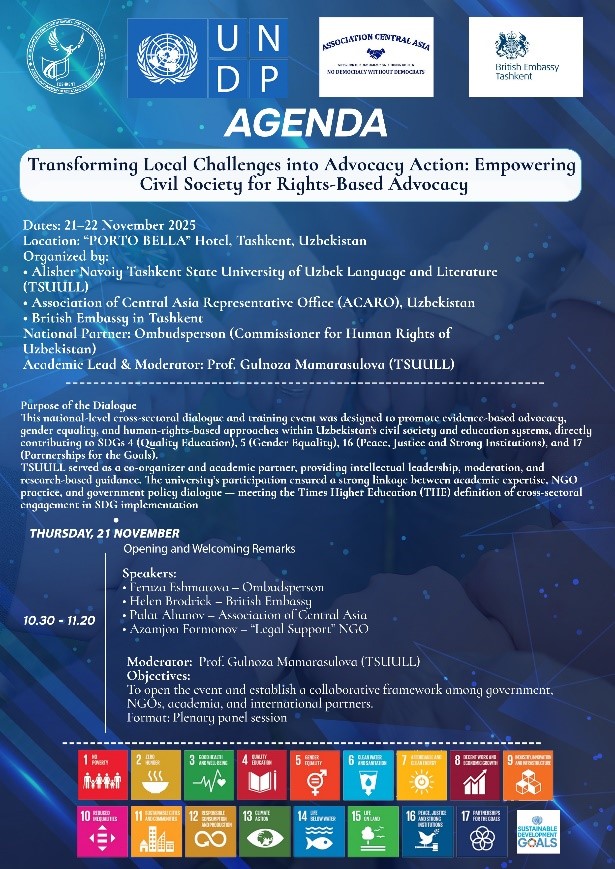
TSUULL is a co-organiser and content leader in Uzbekistan’s largest recent SDG advocacy event:

“Transforming Local Challenges into Advocacy Action: Empowering Civil Society for Rights-Based Advocacy”

(21–22 November 2025, Porto Bella Hotel, Tashkent)

Organisers: TSUULL | ACARO | British Embassy in Tashkent
National Partner: Office of the Ombudsperson

Agenda highlights include:

  • •  Opening policy panel moderated by TSUULL Professor Mamarasulova
  • •  Sessions on human rights, gender equality, vulnerable groups, and advocacy
  • •  Local problem identification and participatory solution mapping
  • •  Development of 20+ advocacy action plans by NGO participants
  • •  Measurable recommendations for SDG 4 and SDG 5 implementation

This event provides documented proof of TSUULL’s direct institutional involvement in:

  • •  Multi-stakeholder SDG policy dialogue
  • •  Government–NGO–university coordination
  • •  Evidence-based strategy development
  • •  SDG monitoring processes

A) National & Local Governance

  • •  TSUULL’s Rector, as an elected Deputy of the Tashkent City Council, participates directly in municipal SDG policy development.
  • •  TSUULL experts co-develop local strategies on education quality, access, youth development, and women’s empowerment in five city settlements.
  • •  Collaboration with the Ministry of Preschool and School Education supports national SDG 4 implementation.

B) Sectoral Ministries
•  Ministry of Defence: 150+ officers annually trained in ethics, communication, and peacebuilding (SDG 16).
•  Ministry of Internal Affairs (Corrections): 50+ staff trained in Penitentiary Psychology, improving human-rights compliance.
C) Community Outreac
1. TSUULL partners with public schools (Nos. 319, 144, 117, 220, 46).
2. Outcomes include:

  • •  250+ teachers trained
  • •  4,800 students engaged

Enhanced digital literacy, inclusion, and modern pedagogy https://tsuull.uz/uz/content/building-partnerships-and-advancing-sdg-education-sustainable-future#tab2

TSUULL’s Comprehensive Policy-Focused Research for Government Departments

TSUULL actively produces policy-relevant research, evaluation tools, and expert analyses in direct collaboration with government bodies at national and regional levels. This includes formal cooperation with:

TSUULL’s research outputs range from policy briefs, monitoring reports, standardized assessment tools, and expert evaluations to strategic documents used in national decision-making. This demonstrates not only academic involvement but direct institutional participation in public policy formation and evidence-based governance.

Empowering Policymakers Through Research, Training, and Public Engagement

We demonstrate a sustained, institution-wide commitment to strengthening public institutions and evidence-based governance through structured collaboration with government bodies, civil-society organisations, and professional communities. The university delivers policy-oriented research, targeted training programmes, and capacity-building initiatives for policymakers, legislators, civil servants, educators, and public-sector specialists across key governance domains, including education reform, law and legal drafting, public administration, migration and displacement, climate resilience, digital transformation, human rights, language policy, and transparent governance.

TSUULL’s approach combines research for government with education for decision-makers. University research teams work directly with national agencies to produce policy briefs, analytical reports, standardized assessment tools, competency frameworks, and expert evaluations that are used in legislative processes, institutional reform, and public-service modernisation. In parallel, TSUULL delivers structured upskilling programmes—including professional courses, executive trainings, public lectures, expert forums, and methodological workshops—designed specifically for policy- and law-makers, senior administrators, and practitioners responsible for implementation at ministerial, regional, and municipal levels.

Beyond formal government engagement, TSUULL operates as a national platform for public dialogue and awareness-raising, hosting regular public talks, open policy discussions, and thematic forums that translate complex policy issues—such as climate sustainability, migration, gender equality, and social inclusion—into accessible knowledge for decision-makers and the wider public. These initiatives strengthen institutional literacy, promote informed policymaking, and foster trust-based dialogue between academia, government, and society.

The university’s leadership structure further reinforces this role. Senior university leadership holds formal responsibilities within legislative and municipal governance bodies, ensuring a continuous feedback loop between community-level realities, academic expertise, and policy formulation. This enables TSUULL to integrate grassroots evidence into national and urban policy discussions, particularly in areas related to poverty reduction, social protection, education access, and inclusive urban development.

At the community level, TSUULL sustains permanent outreach and capacity-building mechanisms through neighbourhood partnerships, community support hubs, and NGO collaboration platforms. These initiatives deliver legal information sessions, digital and financial literacy training, psychosocial support, language education, and employability skills—strengthening local governance capacity while directly supporting vulnerable populations and displaced or at-risk groups.

Internationally and regionally, TSUULL contributes to policy learning and reform dialogue through expert participation in cross-border forums, international advisory networks, and digital knowledge platforms. By sharing national reform experiences and aligning local policies with global standards, the university amplifies its impact beyond national borders and supports policy convergence in areas such as inclusive education, digital governance, and sustainable development.

News Related to Us

  • Community Outreach

      
    TSUULL delivers structured community outreach and public education initiatives that build policy literacy and governance capacity beyond the university. Through public talks, open lectures, community workshops, and neighbourhood-based programmes, the university addresses critical topics such as education reform, social inclusion, migration, climate awareness, legal rights, and digital literacy. These initiatives engage civil servants, educators, local leaders, and community representatives, strengthening their understanding of policy challenges and supporting informed decision-making at the local level.

  • TSUULL Expertise for Government Decision-Making

    TSUULL provides direct, systematic expertise to national and regional government bodies through policy-focused research, analytical reports, standardized assessment tools, and professional guidance. University experts collaborate with ministries, state agencies, and parliamentary structures on issues including education policy, language regulation, legal drafting, public administration reform, migration management, digital governance, and human-rights compliance. In parallel, TSUULL conducts targeted upskilling and capacity-building programmes—such as executive trainings, methodological seminars, and expert briefings—designed specifically for policymakers, law-makers, and senior public-sector professionals.

  • Social Responsibility, Capacity-Building, and Inclusive Support Mechanisms

    Complementing its formal government engagement, TSUULL operates long-term capacity-building mechanisms that support equitable governance and institutional resilience. Through community support hubs, NGO partnerships, and professional training platforms, the university delivers legal information sessions, digital and financial literacy training, ethics education, and employability skills development. These initiatives strengthen institutional capacity, expand access to knowledge for underrepresented groups, and contribute to more inclusive, transparent, and responsive policymaking in line with the objectives of the Times Higher Education Sustainability Impact Ratings.

TSUULL

STRENGTHENING POLICY THROUGH KNOWLEDGE AND OUTREACH

TSUULL strengthens policy and governance by providing outreach, expert knowledge, and capacity-building for policymakers and law-makers. Through public dialogue, policy-focused research, and targeted training, the university supports informed decision-making in areas such as law, education, migration, digital governance, and sustainable development—contributing directly to stronger institutions and inclusive public policy.